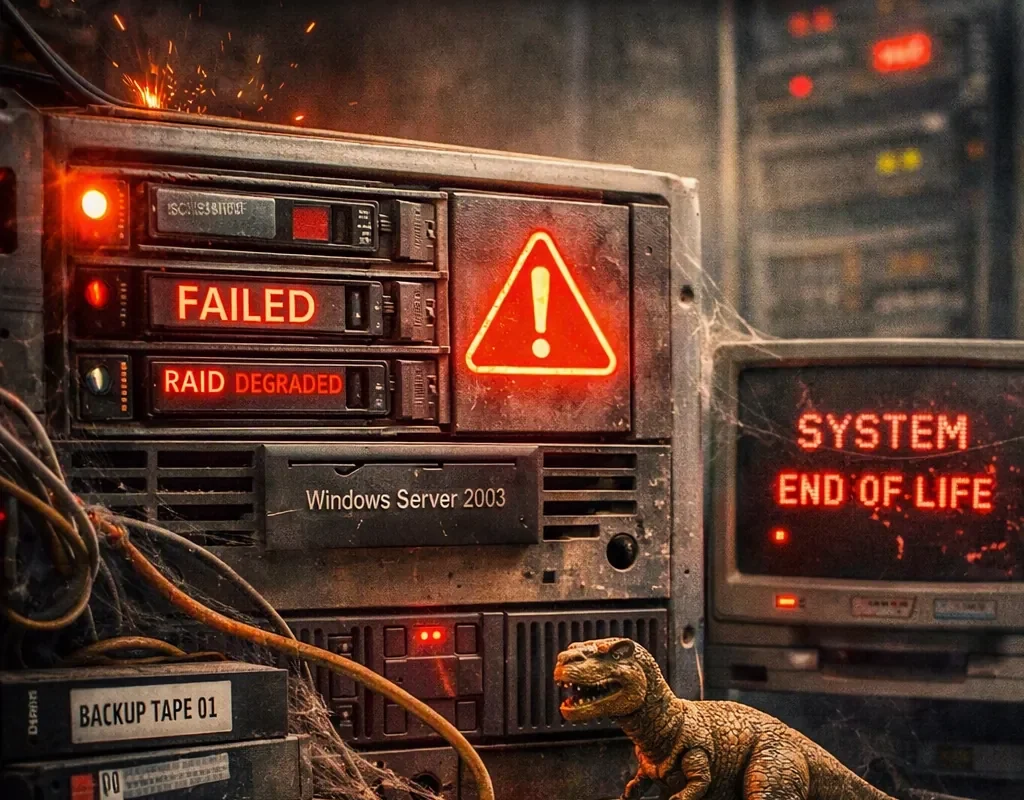

A lot of companies are still running servers that were absolute powerhouses in their day. Machines so good, so stable, that nobody ever dared to replace them. Until one day, time catches up with them.
This week we dealt with a textbook case: a Dell PowerEdge with more than 15 years of service, running a RAID 5 array on a proprietary controller with SCSI drives. Fast back then, but today there are no spare parts and no support. One drive failed, the array went into degraded mode and, since the server kept running, the call was made to “leave it alone.” Big mistake.
The box was running Windows Server 2003, with out-of-support applications and backups on tape. When the second drive died, the manager seemed to think yelling would fix what planning never did. With the patience of a saint, the tech team managed to recover about 85% of the data, but the remaining 15% (the inventory database) was gone for good. More than 100 hours of overtime, partial restores and a whole lot of shared frustration.
This isn’t a one-off. It’s what happens when infrastructure ages without a strategy, when stability gets mistaken for safety and business continuity is left to chance. Tech “dinosaurs” don’t fail because they were poorly built. They fail because nobody planned their replacement.
The takeaway for business leaders
- A server that “still works” is not the same as a system you can rely on.
- Extended support is no substitute for planning.
- Backups need to be tested, not just exist.
- Migration is an investment, not an expense.
Solid technology is valuable, but without maintenance and a planned replacement it becomes a silent risk. So here’s the question: how many dinosaurs are still running in your company, just waiting for the next failure?