
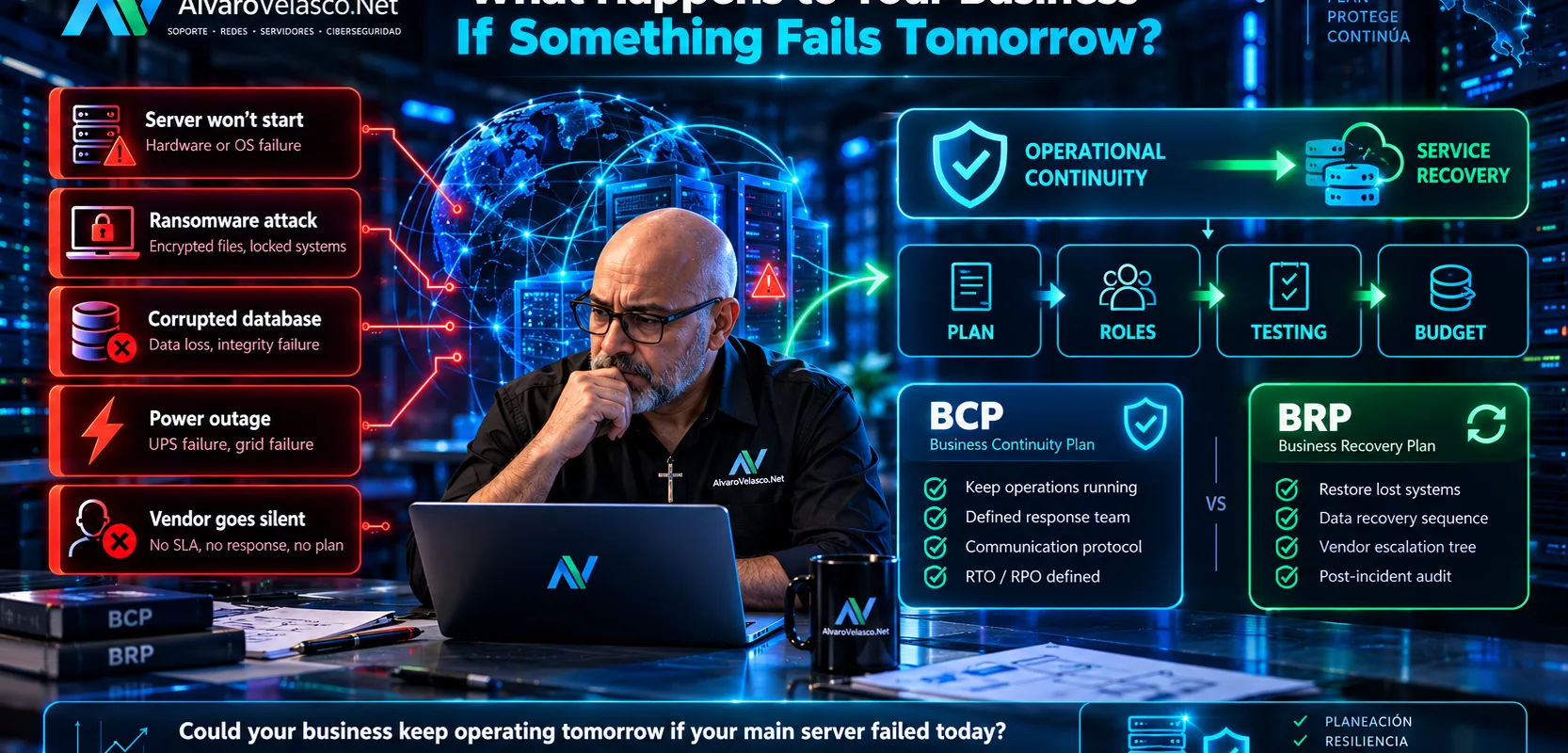
Every business owner thinks they’re ready — until they’re not. A server that won’t power on. A ransomware attack that locks every file on the network. A database corruption that takes down your billing system. A blackout that shuts the office down mid-day. A vendor that stops answering calls right when you need them most.
At that point, business continuity stops being a line item in a tech proposal and starts being a survival question.
Most small and mid-sized businesses run on a reactive model. When something breaks, someone starts digging through old backup drives, calls whatever IT contact they can reach, and hopes the situation resolves itself before customers notice. No playbook. No chain of command. No timeline. Just scrambling.
A Business Continuity Plan (BCP) is the blueprint for keeping your business running while the crisis unfolds. A Business Recovery Plan (BRP) is the roadmap for getting back to normal once the damage is done. Both require the same thing most SMBs don’t have built in advance: a clear plan, defined roles, regular drills, and a budget that treats resilience as an operating expense — not an afterthought.
Enterprise companies have known this for decades. Fortune 500s run quarterly disaster simulations. They define Recovery Time Objectives (RTO) and Recovery Point Objectives (RPO) down to the hour. They keep asset inventories current and audit their continuity plans annually. For them, continuity is a process — not a prayer.
For small businesses, it often comes down to whoever is available and how recently someone remembers running a backup. There’s no incident response manual. No escalation matrix. No tested fallback system. Every crisis is a fire drill the team has never actually practiced — and the cost of improvising always exceeds the cost of planning ahead.
The hard truth: You don’t get to improvise your way through a real disaster. A continuity plan won’t stop bad things from happening. But it will stop a bad day from turning into the day you closed your doors.
Here’s the question worth sitting with: If your main server went down tonight, could your business be operational by tomorrow morning? If you’re not immediately sure the answer is yes — you don’t have a plan. You have hope.
And hope is not a strategy.