
In today’s business environment, “digital transformation” has become a standard talking point. Nearly every organization says it is a priority. Yet in practice, a clear pattern keeps emerging: the technology arrives — the culture does not follow.
Systems are deployed. Cloud services are provisioned. Hardware gets refreshed. But two years later, operations look remarkably similar to what they did before, because the decision-making habits around technology never actually changed.
How Enterprises and SMBs Approach Technology Differently
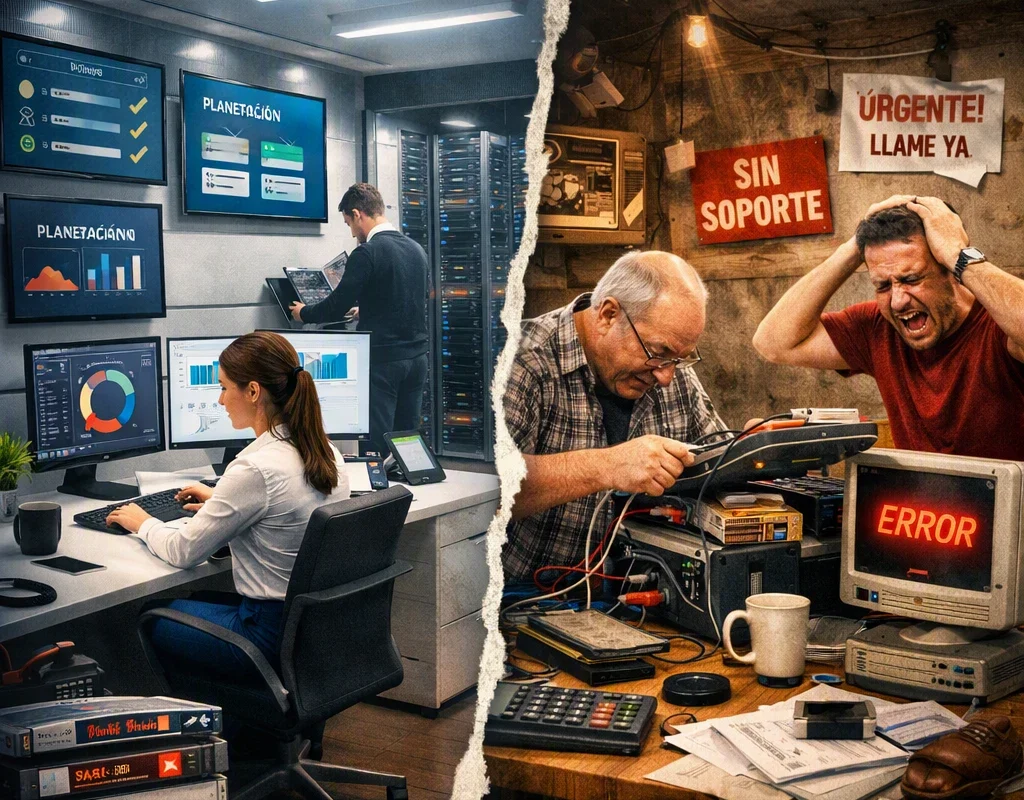
Established enterprises tend to manage technology as a discipline. Equipment operates within a defined lifecycle. Infrastructure upgrades are planned and budgeted well in advance. Annual security and systems audits are standard practice. The organization treats technology as an ongoing investment — not an emergency line item.
Small and mid-sized businesses typically operate under different constraints. Once a device exceeds four years of service, it transitions from “investment” to “expense” — and expenses get deferred. Preventive support agreements are seen as optional. Asset inventories are incomplete or nonexistent. There is no replacement roadmap.
Instead, there is reaction. When something fails, the response is to find whoever is available at the lowest cost.
Technology Alone Is Not a Transformation
Genuine digital transformation is not a procurement decision. It is a shift in how an organization manages, maintains, and evolves its technology — a cultural change as much as a technical one. Without that shift, new tools are simply layered on top of the same reactive habits, and the outcomes reflect it.
- Without a culture of planning, technology becomes a series of temporary fixes.
- Without defined processes, IT support is permanently in crisis mode.
- Without a roadmap, every solution addresses today’s problem while setting up tomorrow’s.
Research consistently shows that more than 80% of small businesses operate under this reactive model — not from lack of interest, but from lack of structure, defined budget, and strategic guidance.
The Real Cost of Deferred Planning
There is a widely held assumption in smaller organizations: “We cannot afford proactive IT support.” The more accurate calculation, however, points in the opposite direction: unplanned failures are consistently more expensive than the prevention that would have avoided them.
An unplanned system outage translates directly into lost productivity, extended recovery timelines, and potential client-facing disruptions. In more serious cases, organizations face permanent data loss — from servers that were never reviewed, licenses that lapsed without notification, or backup systems that were never verified in practice. These are not unlikely scenarios. They are predictable outcomes of deferred maintenance.
Reactive IT management is not a cost-saving strategy. It is a payment schedule — one that typically arrives at the worst possible moment.
Four Priorities That Drive Real Change
Closing the gap between technology investment and cultural readiness does not require a large budget. It requires clarity and commitment:
- Engage a long-term technology partner — not a transactional vendor. The distinction matters. A partner understands your environment, tracks its evolution, and identifies issues before they become failures. A vendor responds when called.
- Establish and maintain a complete asset inventory. Knowing exactly what equipment is in service, when licenses expire, and when replacements are due eliminates the majority of unexpected IT disruptions.
- Define a 12-month technology roadmap. Identify what will be upgraded, what will be secured, and what will be retired — with dates attached. A technology goal without a timeline is not a plan.
- Reclassify technology as investment, not overhead. Equipment and systems maintained properly perform better, last longer, and generate significantly lower total cost of ownership over time.
Prevention Is Not a Philosophy — It Is Arithmetic
Every organization that has made the shift from reactive to proactive IT management has arrived at the same conclusion: the cost of structured prevention is consistently lower than the cost of unstructured response. That is not a marketing position. It is what the numbers show, year after year.
AVN Networks has spent over 30 years supporting organizations through exactly this kind of transition — not by selling hardware, but by building the environments, processes, and long-term relationships that keep businesses operational and resilient.
Technology without culture is just hardware. Culture with technology is progress.
Learn how AVN Networks can help your organization build a proactive IT strategy →